I Ching Reading for 2026
by Nori Muster
The I Ching or Yijing, dates back to 1000 BCE. As the Confucian, Taoist, and Buddhist religions formed, they adopted the I Ching as a seminal manuscript of moral behavior.
The I Ching is a book of sixty-four Hexagrams, that tell stories of how people react to situations. In each story, some of the people have a positive way to deal with things, while others are not skilled at dealing with life's problems.
Over the centuries, people have turned to the I Ching to look for a Hexagram that will guide them to the best attitude in their situation. The inquirer concentrates on a question, then chooses a Hexagram.
We have witnessed many changes in 2025, some of which have been traumatizing. In the United States, things such as the economy improved after COVID, but now institutions we thought were permanent seem threatened. We're unsure where this current is leading us. With these thoughts in mind, I consulted the I Ching and was given two hexagrams.

Hexagram 4
Correcting Mistakes
The subject of the first line (yin) is a teacher working with children. She is tolerant, but firm. When there is a problem, she acts to correct things, and does not act out of anger. Acting out when we feel angry drives people away and doesn't do any good. We all make mistakes nearly every day. Mistakes are how we learn, and it begins in childhood. Most of us gradually learn to make better decisions as we gain more life experience.
The subject of the second line (yang) is a child, who grows up to become the head of a family. The message is that we need children to grow up and become responsible, rational adults with good attitudes and natural good behaviors.
The subject of the third line (yin) is an adult who makes bad decisions, including marrying for money. The I Ching says marriage based on money is not a relationship of love and trust. It's a bad decision because if the truth were to come out, it could make both partners suffer.
The fourth line (yin) confirms that if we continue to act like children, we will struggle throughout life. In our current age, we thankfully have abundant research in psychology, and the resulting anderstanding of how to reclaim our lives and mature into adulthood. Sadly, immature adults who continue to act as if they're children often make bad mistakes that bring consequences, forcing them to change. This is learning the hard way.
The fifth line (yin) advises parents to shelter their children from the difficult problems of life. There's no reason to purposely expose children to trauma they can't handle. Children will learn soon enough how painful life can be.
The sixth line (yang) shows a child who finds life difficult, and has trouble coping. Because of neglect or abuse, the child does not have the tools to develop adult attitudes and behaviors. The I Ching says it is better to help people like this, than to mock them. No matter how old we get, if we put in the work, we can still become functioning adults.
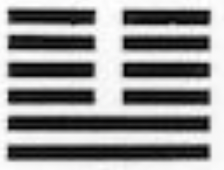
Hexagram 19
Wise Management
This Hexagram explains how management works, and how important it is for children to grow up to be capable adults. The first and second lines (both yang) show the level of cooperation it takes to manage the inevitable problems of running a business.
The subject in the first line is disciplined. This person does everything necessary to create a positive work environment. The subject in the second line has a good imagination. As the two work together, their insights and ideas assure they can resolve almost anything that comes their way.
Line two reveals that these subjects are a metaphor for what's already within us. One side of the brain is creative, and the other side is disciplined. They work together, so that we can tap into both areas and succeed.
The last four lines in Hexagram 19 are yin, and they each confirm the need for competent people. The third line confirms the power of the two subjects who work together, because they restore balance. The fourth line says working in harmony can prevent disasters and provide the knowledge and inspiration to correct things. The fifth line says imagination and discipline will lead to success. The sixth line says success comes from discipline, integrity, imagination, and creative work.
We do not choose the managers of the world, and we can't fix all the immature adults. That's out of our sphere of influence. We hae the most influence when we each work on our attitudes, behaviors, and goals. In the coming years, staying in good emotionally shape, and helping when we are called, will spread joy, and eliminate fear.
About the author
Nori Muster wrote Learning to Flow with the Dao: The 64 Hexagrams of the I Ching, as well as books on positive psychology, and her memoir, Betrayal of the Spirit: My Life behind the Headlines of the Hare Krishna Movement. Visit Surrealist.org, to read your I Ching.
This essay originally appeared in Sedona Journal of Emergence, Predictions 2026 & Beyond, Annual Predictions Issue 2025-2026.
The 64 Hexagrams of the I Ching: Learning to Flow with the Tao
The I Ching is the ancient Taoist book of metaphors, written to offer guidance in the inevitable changes of life. The I Ching consists of sixty-four hexagrams, the number of combinations mathematically possible with six solid and broken lines. The broken lines "- -" are yin, or passive, dark, yielding. The solid lines are yang, active, light, reaching. Ancient Taoist scholars recorded meanings for each of the sixty-four combinations.
Your future is in your hands. Consult the I Ching for ideas that lead to clear thinking and positive mental attitude. The I Ching teaches you to flow with changes. Create positive change from the inside through conscious living. Take the time to reflect on your attitudes and ideas.
This interpretation of the ancient text I Ching has been online since 2000. Thousands of visitors have accessed the oracle through Surrealist.org. Now it is available at Amazon. Learn to flow with change instead of resist it.
Learning to Flow with the Dao (paperback or e-book) at Amazon.com - click here
I Ching reading (free) at Surrealist.org - click here.
Index
